

Traditional Use & Responsible Guidance
Traditional Use & Responsible Guidance
Product information is provided for educational and culinary purposes. Traditional use does not establish medical effectiveness. These products are not intended to diagnose, treat, cure, or prevent disease. Review ingredients and product-specific cautions; consult a qualified professional if pregnant, nursing, taking medication, managing a condition, or unsure whether a product is appropriate.
NutriBotanix
Wildflower Honey
Wildflower Honey
Couldn't load pickup availability
Wildflower Honey
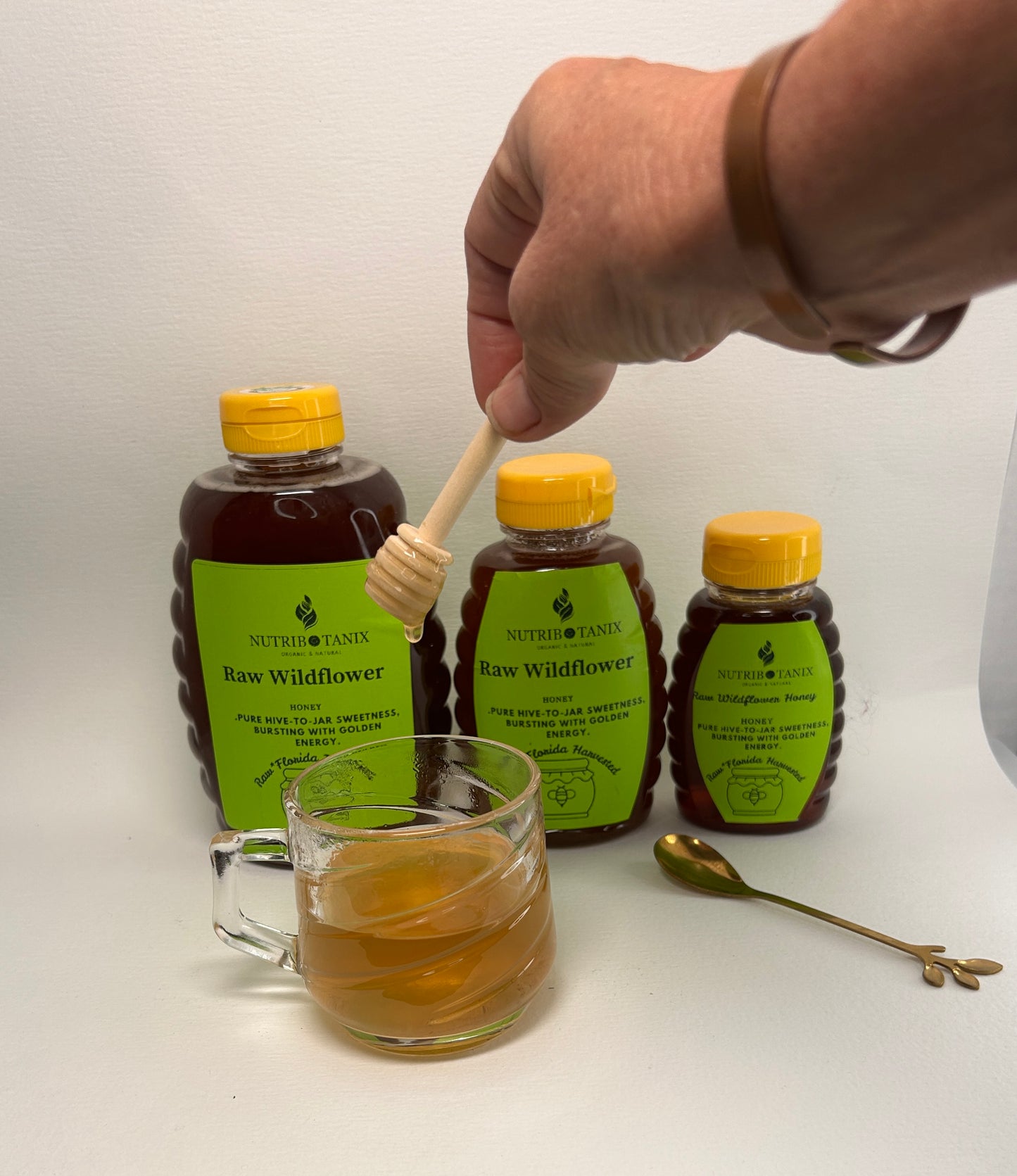
A raw Florida honey, gathered by honeybees foraging across the wildflower-rich landscape of the Clermont–Leesburg area in Central Florida. This is an everyday honey — versatile, naturally sweet, and produced in volume from one of Florida's most active and diverse nectar regions. It is the honey that earns a permanent place on the kitchen counter.
What is wildflower honey?
Wildflower honey is a multifloral honey, meaning the bees forage from a diverse range of flowering plants rather than a single dominant species. Unlike monofloral varietals — where bees are managed to concentrate on one bloom — wildflower honey reflects the full seasonal range of whatever is flowering in the area during the harvest period. In Central Florida, that includes saw palmetto, gallberry, Brazilian pepper, clover, various native wildflowers, and a rotating cast of blooming plants that shift with the season.
This diversity is what makes wildflower honey well-suited to everyday use. It does not have the narrow, specific profile of a varietal honey. It has a broad, familiar sweetness that works across a wide range of foods, drinks, and applications without asserting itself too strongly in any one direction.
Region
This honey is sourced from the Clermont–Leesburg area of Lake and Sumter Counties in Central Florida — a region of rolling hills, lakes, and mixed agricultural and natural land that sits along Florida's Lake Wales Ridge. The terrain here is unusually varied for Florida: sandy uplands, wetland margins, citrus groves, and open pasture land all exist in close proximity, supporting a wide range of flowering plants across the year. The region's long growing season allows bees access to a changing sequence of flowering plants throughout much of the year, contributing to the character of Central Florida wildflower honey.
Color & appearance
Golden amber — warmer and deeper in color than orange blossom honey, reflecting the wider range of nectar sources contributing to the blend. The exact shade varies by season and harvest: spring batches tend to run lighter, while late-summer harvests often come in richer and deeper. All variation is natural. Raw wildflower honey has a warm, golden transparency when freshly extracted that gradually shifts as it ages or begins to crystallize.
Flavor notes
Straightforward and pleasantly sweet, with a mild floral character and a clean finish. Central Florida wildflower honey is not sharp, bitter, or heavily complex — it is approachable and familiar. There is a gentle warmth in the mid-palate from the diversity of nectar sources, and the sweetness is well-rounded rather than one-dimensional. It does not dominate food the way a strong varietal might. It sweetens, complements, and gets out of the way. Subtle variation in flavor between harvests is normal and reflects the seasonal shift in which plants are in bloom.
Texture & crystallization
Raw wildflower honey crystallizes more readily than Tupelo or sourwood varieties, typically within a few months of harvest when stored at room temperature. This is normal behavior for multifloral raw honey — glucose from the diverse nectar sources precipitates over time, turning the honey from a pourable liquid into a thick, spreadable set. Crystallized wildflower honey has a creamy, smooth texture that many people prefer for spreading on toast or biscuits. To return it to a liquid state, place the bottle in warm (not hot) water and stir or shake gently. The PET Queenline bottle makes this process easy — no need to transfer to another container.
Everyday uses
Wildflower honey is the most versatile honey in the catalog. Its mild, broadly sweet character means it works in almost any application without requiring adjustment or pairing consideration. It is the honey to reach for by default.
- Stir into coffee, tea, or warm lemon water as an everyday sweetener
- Drizzle over oatmeal, yogurt, granola, or fresh fruit at breakfast
- Use as a 1:1 replacement for sugar or simple syrup in baking and cooking
- Spread over toast, cornbread, pancakes, or waffles
- Mix into marinades, glazes, and sauces for roasted meats and vegetables
- Stir into salad dressings and vinaigrettes
- Use as a natural sweetener in smoothies and blended drinks
- Add to peanut butter or almond butter for a simple sandwich spread
- Keep a large jar on hand for family cooking — it holds well and is always useful
Bulk sizes (5 lb and 10 lb) are available at select local markets and events.
Tea pairings
Florida wildflower honey is a natural partner for almost any tea in the NutriBotanix catalog. Its mild, broad sweetness doesn't compete with delicate botanicals and softens the bitterness of stronger blends without masking their character. It works particularly well stirred into Masala Tea Leaves, where it rounds out the spice without dulling it. In Kashmiri Kahwa, it integrates cleanly with the cardamom and rose petals. For everyday morning use, it pairs well with Pick Me Up Gently Tea and Stay Fit Tea. For evening cups, it mellows naturally into Quiet Time Tea and Awww! Those Days Tea. When in doubt about which honey to use with a NutriBotanix tea, wildflower is the reliable default.
Frequently asked questions
Is this honey raw?
Yes. This honey is raw and unfiltered, meaning it has not been heated or processed in ways that would alter its natural enzyme content, pollen profile, or flavor. Color and flavor may vary between batches, which reflects seasonal changes in the flowering landscape around the hive sites.
Why is it sold in larger sizes?
Wildflower honey is designed for everyday use — cooking, baking, sweetening, spreading. Larger sizes are more practical and more economical for households that use honey regularly. Bulk sizes (5 lb and 10 lb) are available at select local markets and events.
Why has my honey gone thick or grainy?
It has crystallized — a natural process in all raw honeys, and particularly common in multifloral varieties like wildflower. It is not spoiled. Crystallization happens when glucose in the honey forms crystals over time. The honey is still perfectly good. To reliquefy, place the bottle in warm water and stir gently. The PET bottle is designed to withstand this process safely.
Is this the same honey used in Vital Power Honey?
Yes — the base honey in NutriBotanix Vital Power Honey is Florida raw wildflower honey from the same Central Florida source. Vital Power is an artisanal blend that infuses this honey with organic Himalayan shilajit. The wildflower honey here is the same source, offered on its own.
How should I store it?
At room temperature, away from direct sunlight and heat. Refrigeration is not recommended — it accelerates crystallization without providing any preservation benefit. Raw honey does not spoil.
A note on raw honey
All NutriBotanix honeys are raw and minimally processed. Raw honey has not been pasteurized or micro-filtered. It may contain naturally occurring pollen, propolis traces, and small air bubbles. These are normal characteristics of unprocessed honey, not defects. Because raw honey may contain naturally occurring spores, it is not recommended for children under 12 months of age.
Sourcing & traceability
This honey is sourced from the Clermont–Leesburg area of Central Florida, where bees forage across a changing seasonal mix of wildflowers and agricultural blooms. Each harvest may vary naturally in shade, aroma, and flavor. Explore Honey Learning Center for more about raw honey, sourcing, and harvest variation.
Continue your honey journey
Compare regional and floral differences in the Honey Varietal Guide, or browse the Florida Raw Honey collection. When you want a more distinctive seasonal profile, continue to Rare & Seasonal Honey.
Education note: Origin, flavor, culinary use, and traditional honey information are provided for education and do not diagnose, treat, cure, prevent disease, or replace professional medical advice.
Share