

Traditional Use & Responsible Guidance
Traditional Use & Responsible Guidance
Product information is provided for educational and culinary purposes. Traditional use does not establish medical effectiveness. These products are not intended to diagnose, treat, cure, or prevent disease. Review ingredients and product-specific cautions; consult a qualified professional if pregnant, nursing, taking medication, managing a condition, or unsure whether a product is appropriate.
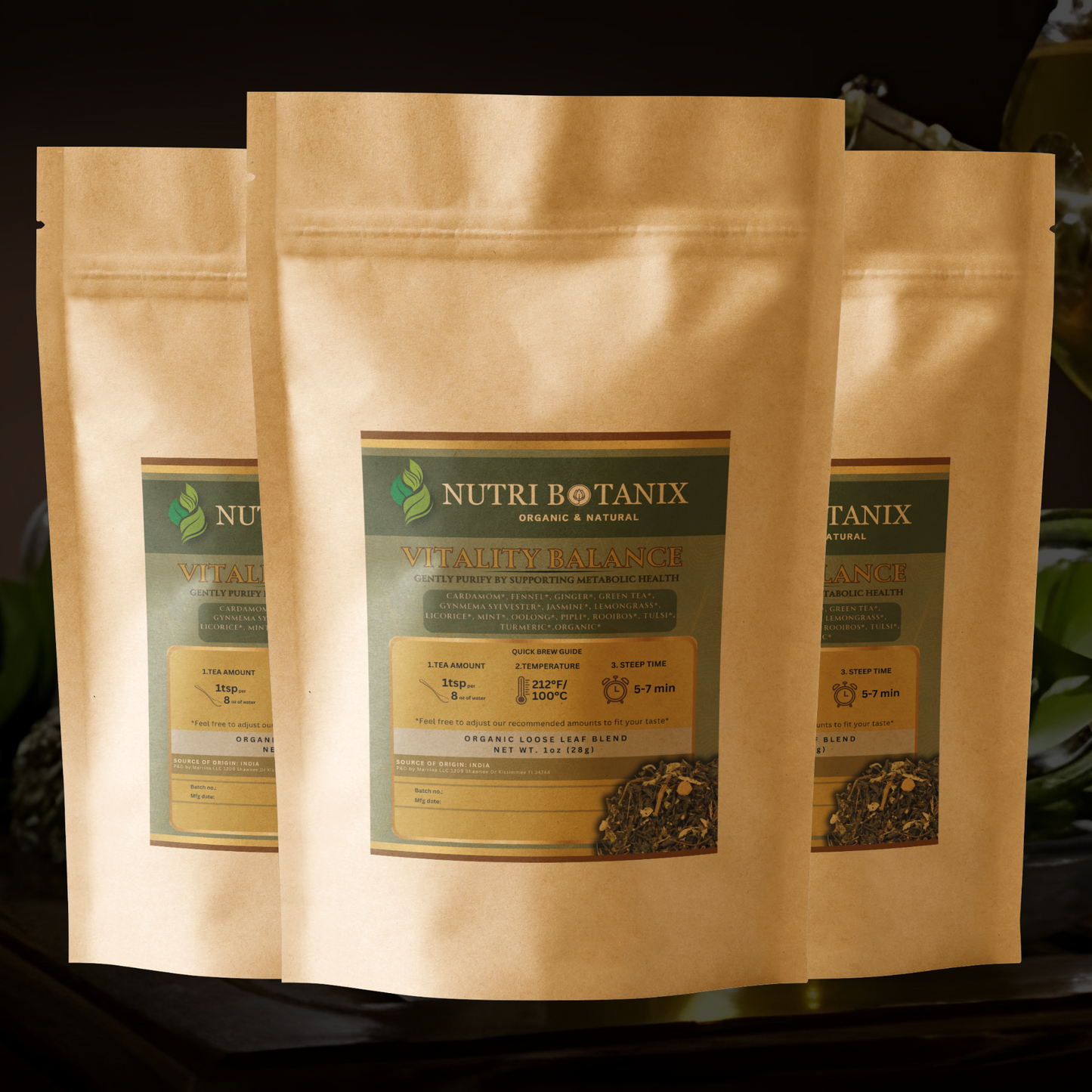
NutriBotanix
Vitality Balance Tea
Vitality Balance Tea
Couldn't load pickup availability
A Fourteen-Botanical Blend from Four Tea Traditions
Most tea blends draw from one tradition. Vitality Balance draws from four.
Green tea and oolong from the East Asian Camellia sinensis tradition. Rooibos from the fynbos shrublands of South Africa's Western Cape. Jasmine flowers from the Chinese tea-scenting tradition. And a core of Ayurvedic botanicals — tulsi, turmeric, ginger, cardamom, licorice, pipli, gymnema — that have been cultivated and used across the Indian subcontinent for thousands of years. Lemongrass, fennel, and mint complete the blend.
Fourteen ingredients. One cup. A genuinely global botanical story.
Caffeine notice: This blend contains both green tea and oolong, both of which are Camellia sinensis teas and naturally caffeinated. Rooibos is naturally caffeine-free and does not offset the caffeine contribution of the tea leaves. This is not a caffeine-free or low-caffeine blend.
The Ingredients
Green Tea — A lightly oxidized leaf from the Camellia sinensis plant, prized across East and South Asia for its clean, grassy flavor profile and long cultivation history. Green tea forms part of the base structure of this blend alongside oolong, contributing both flavor and naturally occurring caffeine.
Oolong — Oolong occupies the middle ground between green and black tea in the oxidation spectrum — partially oxidized, producing a flavor profile that is more complex and less grassy than green tea but lighter and more aromatic than black. Oolong has a centuries-long history in Chinese tea culture, particularly associated with Fujian province and the Wuyi mountains. In this blend, it adds depth and a roasted, floral character that green tea alone does not provide.
Rooibos — Rooibos (Aspalathus linearis) grows exclusively in the Cederberg mountain region of South Africa's Western Cape province. It is harvested from a fynbos shrub endemic to that specific geography — it cannot be cultivated anywhere else in the world. Naturally caffeine-free, rooibos has a mild, slightly sweet, earthy flavor with a reddish color. It is the only ingredient in this blend with African botanical origin, and its inclusion gives Vitality Balance Tea a genuinely global character.
Jasmine Flowers — Dried jasmine flowers have been used in Chinese tea culture for centuries, most famously in the tradition of scenting green tea with fresh jasmine blossoms. In this blend, jasmine flowers are included as a standalone botanical ingredient, contributing a delicate, intensely floral aroma and a gentle sweetness that softens the more assertive spice and herbal notes.
Tulsi (Holy Basil) — Among the most revered botanicals in Indian culture, tulsi (Ocimum tenuiflorum) is known as the Queen of Herbs in Ayurvedic tradition. Grown in households across the subcontinent, used in religious ceremonies, and widely classified as an adaptogenic botanical in Ayurvedic practice, tulsi has been part of classical Indian herbal tradition for thousands of years. It contributes a complex, slightly clove-like, aromatic flavor with a subtle warmth.
Turmeric — The golden rhizome of Curcuma longa, cultivated across South Asia for over four thousand years. A cornerstone of Indian cooking and Ayurvedic botanical practice, turmeric contributes a warm, earthy, faintly bitter note and lends the cup a characteristic golden tone. Its presence alongside ginger, cardamom, and pipli reflects the classical Ayurvedic approach to warming spice formulation.
Ginger Root — One of the most universally used botanical and culinary ingredients across South Asian, East Asian, and Ayurvedic culinary and herbal traditions. Dried ginger contributes a sharp, warming spice character and forms part of the Ayurvedic spice core of this blend alongside turmeric, cardamom, and pipli.
Cardamom — The aromatic seed pod of Elettaria cardamomum, native to the forests of southern India and cultivated across South Asia and Guatemala. Cardamom is one of the world's oldest traded spices, documented in ancient Sanskrit texts, Greek botanical records, and Ayurvedic pharmacopoeia. It contributes a sweet, floral, faintly eucalyptus-like aroma that ties together the spice and floral layers of this blend.
Licorice Root — Licorice (Glycyrrhiza glabra) carries one of the longest cross-cultural histories of any botanical ingredient — documented in ancient Egyptian, Greek, Roman, Chinese, and Ayurvedic records. Known as yashtimadhu in Ayurveda and gancao in Chinese medicine, it contributes an intensely sweet, anise-like flavor that provides natural sweetness and depth. Licorice is one of the more assertive flavor notes here — taste before adding honey.
Pipli (Long Pepper) — Piper longum is a close botanical relative of black pepper, native to South Asia, and one of the most important spice ingredients in classical Ayurvedic formulation. It is one of the three components of Trikatu — a classical Ayurvedic warming spice formula consisting of long pepper, ginger, and black pepper — referenced extensively in the Charaka Samhita and Sushruta Samhita. Long pepper has a flavor that is simultaneously hotter and more complex than common black pepper, with fruity and slightly sweet undertones beneath the heat. It is rarer in Western markets than black pepper and represents one of the more historically interesting ingredients in this blend.
Gymnema Sylvestre — Gymnema (Gymnema sylvestre) is a woody climbing shrub native to the tropical forests of India, Africa, and Australia, and one of the more unusual botanical ingredients in Ayurvedic tradition. Known in Hindi as gurmar, gymnema leaves have the remarkable property of temporarily suppressing the perception of sweetness on the tongue when chewed or held in the mouth. This is not a flavor contribution in the traditional sense; rather, gymnema has an almost neutral character in brewed tea. Its presence in this blend reflects the Ayurvedic formulation tradition and its centuries-long documented history in classical Indian botanical practice.
Lemongrass — Cymbopogon citratus is a tall grass native to South and Southeast Asia, widely used in culinary and tea traditions across the region. Its flavor is bright, citrusy, and clean — a counterpoint to the earthier and spicier elements in the blend. Lemongrass is a fixture of Thai, Vietnamese, and South Indian cooking, and a common tea ingredient across Southeast Asia.
Mint — A universally recognized culinary herb present in tea traditions across South Asia, North Africa, and the Middle East. In this blend, mint adds a cooling brightness that lifts the heavier herbal and spice notes and contributes to the overall aromatic complexity of the cup.
Fennel Seed — A mild, sweet anise-flavored seed used across Indian cooking and commonly offered after meals across the subcontinent. In this blend fennel contributes a gentle sweetness and a light anise note that complements the licorice and cardamom.
About This Blend
Vitality Balance Tea is one of the most botanically complex blends in the NutriBotanix collection — fourteen ingredients drawn from Ayurvedic tradition, Chinese and East Asian tea culture, South African botanical heritage, and South and Southeast Asian culinary traditions. The formulation reflects a global approach to tea blending, bringing together ingredients that have individually accumulated centuries of use in their respective traditions.
NutriBotanix sources ingredients from suppliers that provide documentation and quality standards appropriate for botanical ingredients.
Brewing Instructions
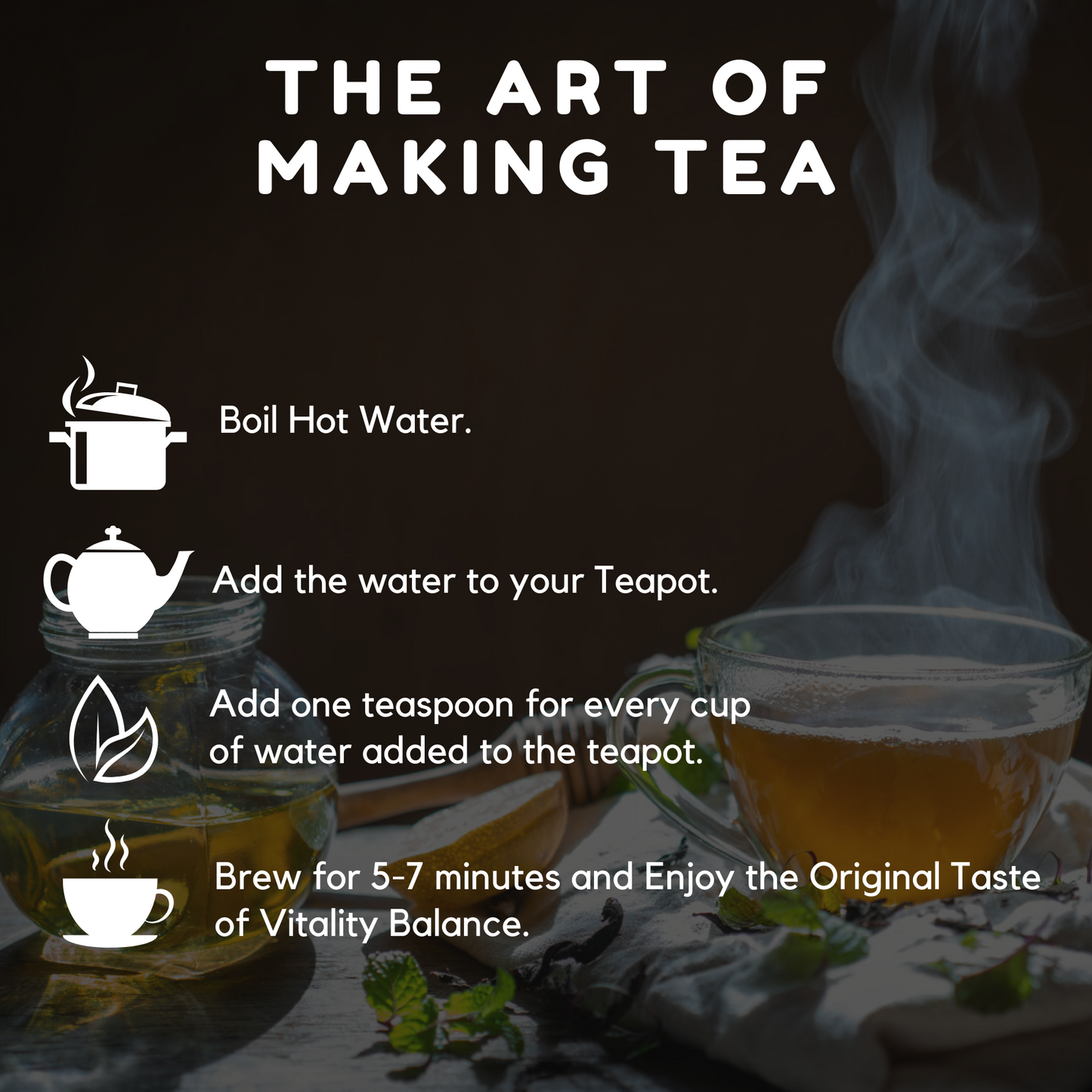
- Amount: 1–1½ teaspoons per 8 oz of water (this is a complex, assertive blend — start with less and adjust)
- Water temperature: 185–195°F (85–90°C) — slightly below boiling to protect the green tea and oolong base
- Steep time: 3–4 minutes
- Vessel: Infuser basket, tea strainer, or French press
- Serve: Plain, or with a small amount of honey — licorice root contributes natural sweetness, so taste first
The flavor of this blend evolves as it cools. The floral notes from jasmine and cardamom become more prominent at slightly lower temperatures.
Honey Pairings
Fourteen ingredients means there are many flavor directions this blend can take. We recommend:
- Orange Blossom Honey — Light and floral, complements the jasmine flowers and cardamom
- Sourwood Honey — Rich and buttery, holds its own against the spice and oolong depth
Brewing Tools
The right tools make loose leaf tea simple.
- Unbleached Disposable Tea Bags — Single-use, unbleached, chlorine-free. Fill, steep, discard. No strainer required.
- Heart-Shaped Tea Infuser — Reusable stainless-steel infuser for everyday loose-leaf brewing. Fits standard mugs and teacups.
Explore More Multi-Botanical Blends
- 5 O'Clock Fighter Tea — Thirteen botanicals rooted in Ayurvedic and cross-cultural botanical tradition
- Sluggishness Crusher Tea — Nine botanicals across Ayurvedic and European herbal traditions
Frequently Asked Questions
Does this tea contain caffeine?
Yes. This blend contains both green tea and oolong, both of which are Camellia sinensis teas and naturally caffeinated. Rooibos is caffeine-free, but its presence does not offset the caffeine contribution of the tea leaves. This is not a low-caffeine or caffeine-free product. Brewing at lower temperatures or for shorter times will reduce caffeine extraction.
What does it taste like?
Complex and layered. The oolong and green tea base provides structure. Licorice and cardamom contribute prominent sweetness and floral warmth. Jasmine adds a delicate perfume. Ginger and turmeric bring earthy spice. Lemongrass gives it a bright citrus note. Mint adds a cooling lift. Rooibos adds a mild, slightly earthy sweetness in the background. The result is a blend that changes character as it steeps and cools.
What is gymnema sylvestre and why is it in this tea?
Gymnema sylvestre is a botanical with a long history in Ayurvedic practice, known in Hindi as gurmar. It has been part of classical Indian botanical formulations for centuries. In brewed tea at normal quantities, it contributes little detectable flavor — it is included as part of the traditional Ayurvedic botanical formulation rather than as a flavor component.
What is pipli?
Pipli is long pepper — Piper longum — a close relative of common black pepper with a longer documented history in Ayurvedic formulation. It is one of the three components of Trikatu, a classical Ayurvedic spice formula, and has a complex, warming flavor that is somewhat hotter and more nuanced than black pepper.
How much should I use per cup?
Start with 1 teaspoon per 8 oz. Because this blend has fourteen ingredients and prominent licorice sweetness, some people prefer a slightly lighter steep. Adjust to taste.
Is this blend organic?
Ingredients are sourced from suppliers with appropriate documentation. Individual ingredient certifications vary. Contact us for specific sourcing information.
As with all botanical blends, individuals with health conditions, those who are pregnant or nursing, or those taking medications should consult a healthcare provider before use.
† These statements have not been evaluated by the Food and Drug Administration. This product is not intended to diagnose, treat, cure, or prevent any disease.
Share