

Traditional Use & Responsible Guidance
Traditional Use & Responsible Guidance
Product information is provided for educational and culinary purposes. Traditional use does not establish medical effectiveness. These products are not intended to diagnose, treat, cure, or prevent disease. Review ingredients and product-specific cautions; consult a qualified professional if pregnant, nursing, taking medication, managing a condition, or unsure whether a product is appropriate.
NutriBotanix
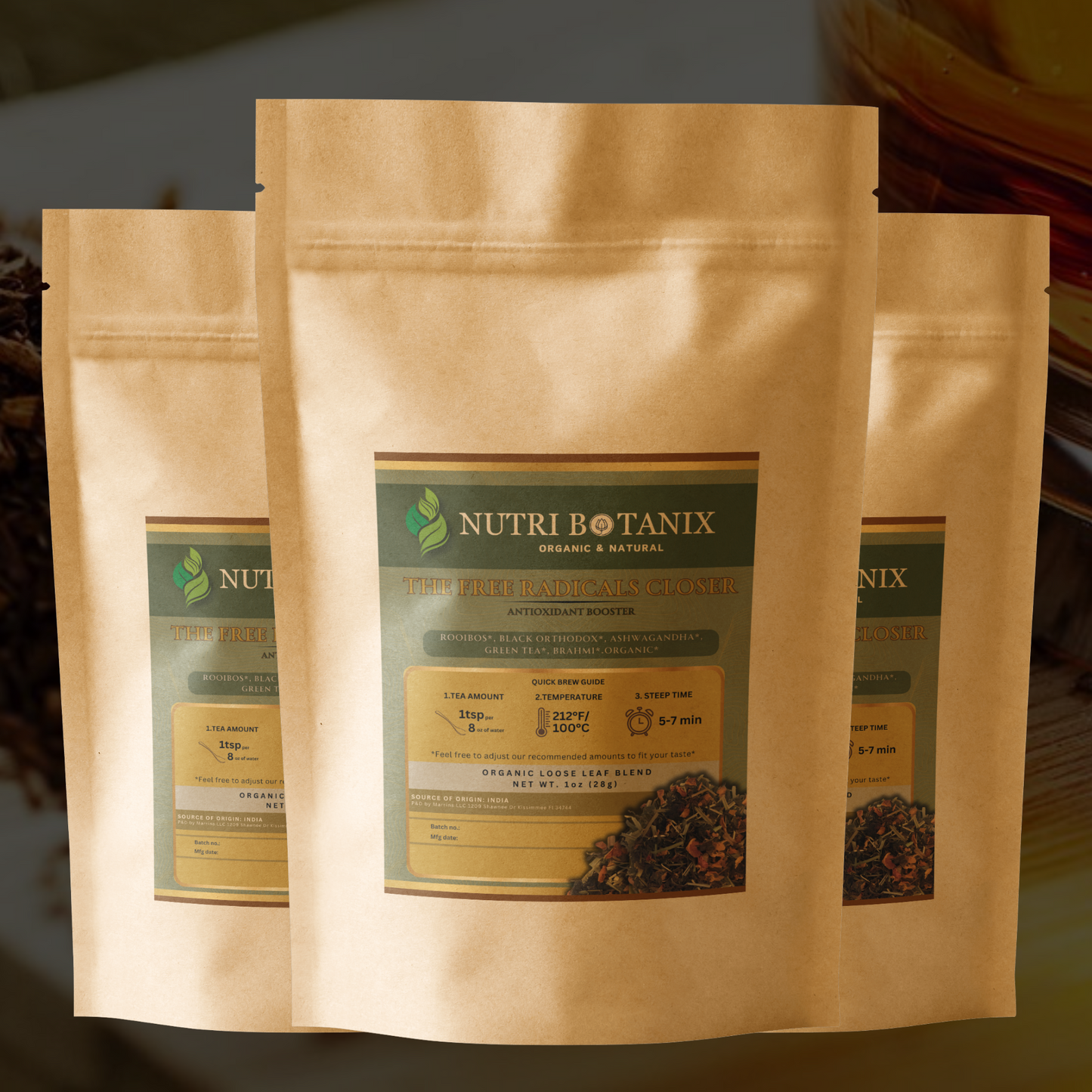
The Free radicals closer tea
The Free radicals closer tea
Couldn't load pickup availability
A Note on Caffeine: This blend contains both black tea and green tea (Camellia sinensis). It has notably higher caffeine content than most blends in our catalog. If you are sensitive to caffeine, please enjoy this tea earlier in the day or consult your healthcare provider.
Free Radicals Closer Tea
A multi-tradition loose leaf blend that brings together botanicals from South Africa, South Asia, and East Asia — each with its own deep history and distinct character. Rooibos from the Cederberg Mountains. Black Orthodox tea from the estates of the Indian subcontinent. Green tea from East Asian tradition. Ashwagandha and Brahmi from the Ayurvedic Rasayana canon. Five botanicals, five traditions, one cup.
The Ingredients
Rooibos (Aspalathus linearis)
Rooibos grows exclusively in the Cederberg mountain range of South Africa's Western Cape — a narrow strip of fynbos wilderness where the plant has been harvested for centuries. The Khoisan people were the first to use rooibos, cutting the needle-like leaves and fermenting them to develop the tea's characteristic deep red color and naturally sweet, earthy flavor. Dutch settlers adopted the plant in the 18th century as a local alternative to imported black tea, and it has remained a cornerstone of South African daily life ever since. Rooibos is naturally caffeine-free, with a smooth, slightly nutty character that rounds out this blend's bolder botanical notes.
Black Orthodox Tea (Camellia sinensis)
Orthodox black tea is produced through a traditional hand-rolled method that preserves the integrity of the full leaf — withering, rolling, oxidizing, and drying — a process that stands in contrast to the CTC (crush-tear-curl) method used for most commercial teabags. The regions of Darjeeling, Assam, and the Nilgiris developed their tea identities through the 19th century, with the British colonial tea trade bringing Camellia sinensis cultivation to the Indian subcontinent at scale. Black Orthodox tea is fully oxidized, producing a bold, full-bodied liquor with depth and structure. It contributes the backbone of this blend's flavor and its higher caffeine presence.
Ashwagandha (Withania somnifera)
Ashwagandha — Sanskrit for "smell of horse," a reference to both the root's distinctive aroma and the vitality traditionally associated with the plant — has been documented in Ayurvedic texts for over 3,000 years. The Charaka Samhita, one of the foundational texts of Ayurvedic medicine, classifies ashwagandha among the Rasayana botanicals — a category of plants used in traditional wellness systems to support balance and resilience over time. It is one of the most well-studied adaptogens in contemporary botanical research. The root has an earthy, slightly bitter flavor that becomes subtle when blended with rooibos and black tea. Adaptogen terminology is used here in its traditional Ayurvedic context, not as a health claim.
Green Tea (Camellia sinensis)
Green tea is produced from the same plant as black tea — Camellia sinensis — but is minimally oxidized, preserving the leaf's natural green color and lighter, more delicate character. Its cultivation history spans over 4,000 years, originating in China before spreading across East and Southeast Asia. Japanese, Chinese, and Korean tea traditions each developed distinct processing methods — steaming, pan-firing, shade-growing — that yield different flavor profiles from the same botanical species. In this blend, green tea contributes a lighter, grassy note alongside the deeper oxidized character of the black Orthodox tea, and adds to the blend's overall caffeine content.
Brahmi (Bacopa monnieri)
Brahmi takes its name from Brahma, the Hindu god of creation and knowledge — a reflection of the botanical's longstanding role in Ayurvedic tradition as a plant associated with mental clarity and learning. It is documented in the Charaka Samhita among the Medhya Rasayanas — Ayurvedic botanicals traditionally used to support cognitive wellbeing — and has been in continuous use across South and Southeast Asia for thousands of years. Brahmi grows naturally in wetland environments and has a slightly bitter, astringent flavor that is tempered by the fuller-bodied botanicals in this blend. Like ashwagandha, Brahmi is recognized as an adaptogen within traditional botanical frameworks.
About the Blend
Free Radicals Closer Tea draws its name not from any clinical promise but from the confluence of botanicals that span centuries of traditional use across four distinct cultural traditions. Rooibos brings warmth and natural sweetness. Black Orthodox tea anchors the blend with structure and depth. Green tea adds lift and complexity. Ashwagandha and Brahmi contribute the earthy, grounding character of Ayurvedic Rasayana tradition. The result is a cup that is layered without being heavy — caffeinated, botanical, and rooted in a genuinely global tradition of plant-based daily ritual.
Brewing Guide
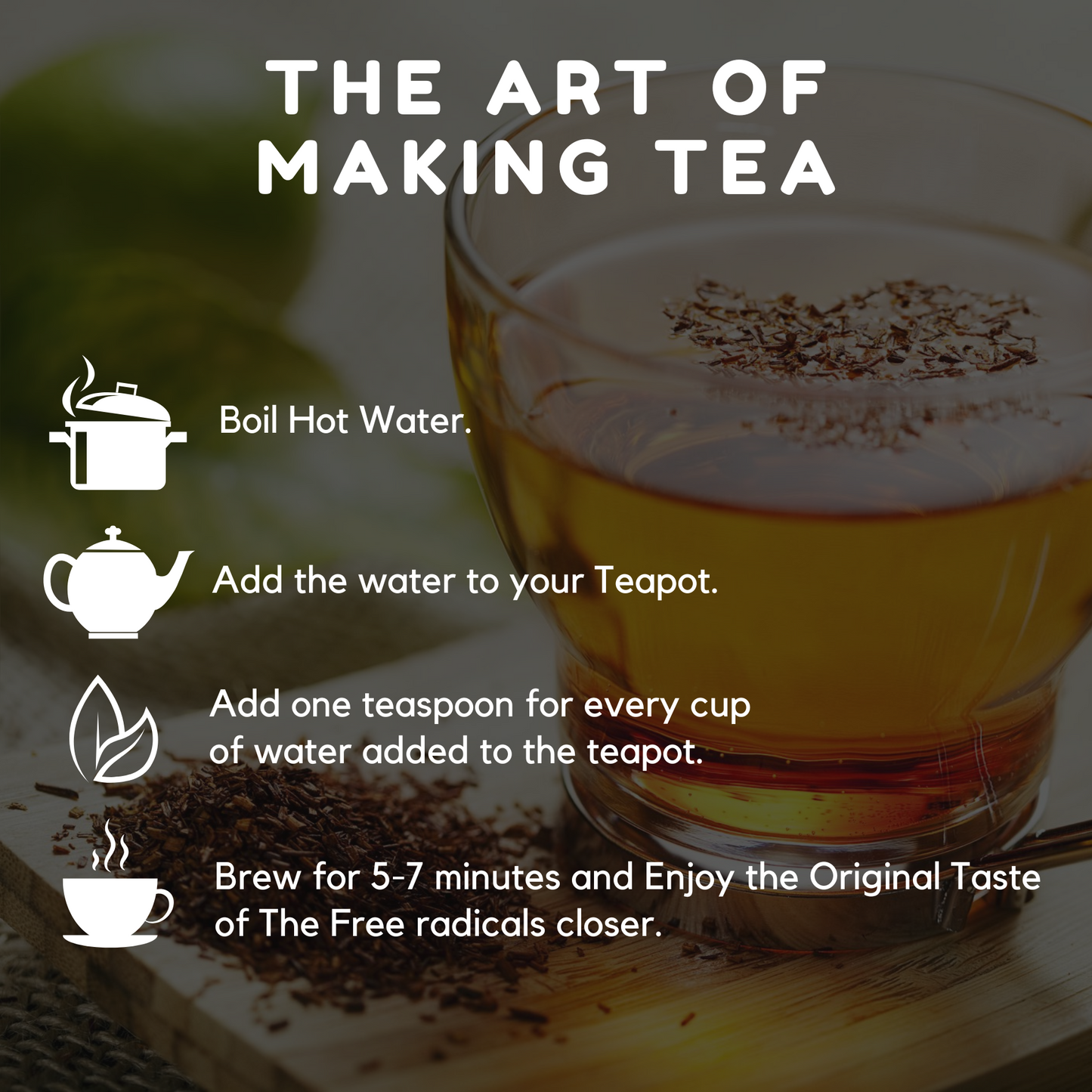
Use 1–2 teaspoons of loose leaf tea per 8 oz of water. Heat water to 185–195°F (85–90°C) — below a full boil preserves the lighter notes of the green tea and rooibos without bitterness. Steep for 3–4 minutes. Remove leaves promptly; steeping longer will intensify bitterness. This blend can be enjoyed plain or with a small amount of honey. A second steep at 195°F for 2–3 minutes is possible for the black tea and rooibos components, though the green tea notes will be lighter on the second pour.
Honey Pairings
This is a bold, layered blend with earthy depth from ashwagandha and brahmi and structure from black tea. It pairs best with honeys that can stand alongside those flavors without disappearing.
- Sourwood Honey — Our primary pairing. Sourwood is harvested from the blossoms of the sourwood tree (Oxydendrum arboreum) in the Appalachian highlands. It has a distinctive buttery, caramel-like flavor with a clean finish that holds its own against the earthiness of this blend. A small amount goes a long way.
- Orange Blossom Honey — A lighter, floral secondary option. Orange Blossom honey is harvested primarily from Florida and California citrus groves during bloom season. Its clean, citrus-kissed sweetness provides a contrasting lift to the blend's deeper botanical notes.
Brewing Tools
The right tools make loose leaf tea simple.
- Unbleached Disposable Tea Bags — Single-use, unbleached, chlorine-free. Fill, steep, discard. No strainer required.
- Heart-Shaped Tea Infuser — Reusable stainless-steel infuser for everyday loose-leaf brewing. Fits standard mugs and teacups.
Related Products
- Sourwood Honey
- Orange Blossom Honey
- MR. T Tea
- Healthy Glow Tea
Frequently Asked Questions
Does this blend contain caffeine?
Yes — this blend contains both black Orthodox tea and green tea (both Camellia sinensis). It has notably higher caffeine content than most blends in our catalog. Enjoy earlier in the day if you are caffeine-sensitive.
Can I drink this every day?
Many customers enjoy loose leaf tea blends as part of their daily ritual. If you have specific health concerns or take medications, consult your healthcare provider about adding any new botanical blend to your routine.
What does "adaptogen" mean as used here?
Ashwagandha and Brahmi are both recognized as adaptogens within traditional Ayurvedic botanical frameworks. This term is used here in its traditional context — it is not a clinical claim about health outcomes.
Is Rooibos really caffeine-free?
Yes. Rooibos (Aspalathus linearis) is naturally caffeine-free. However, because this blend also contains black tea and green tea, the overall blend is caffeinated.
How much should I use per cup?
Start with 1 teaspoon per 8 oz and adjust to taste. The blend has strong flavor components; some customers prefer a lighter steep.
Botanical Consultation Note
This tea contains ashwagandha (Withania somnifera) and brahmi (Bacopa monnieri), both recognized Ayurvedic botanicals. If you are pregnant, nursing, taking medications, or managing a health condition, consult a qualified healthcare provider or Ayurvedic practitioner before regular consumption of botanical blends.
These statements have not been evaluated by the Food and Drug Administration. This product is not intended to diagnose, treat, cure, or prevent any disease.
Share