

Traditional Use & Responsible Guidance
Traditional Use & Responsible Guidance
Product information is provided for educational and culinary purposes. Traditional use does not establish medical effectiveness. These products are not intended to diagnose, treat, cure, or prevent disease. Review ingredients and product-specific cautions; consult a qualified professional if pregnant, nursing, taking medication, managing a condition, or unsure whether a product is appropriate.
NutriBotanix
Only power no shakes tea
Only power no shakes tea
Couldn't load pickup availability
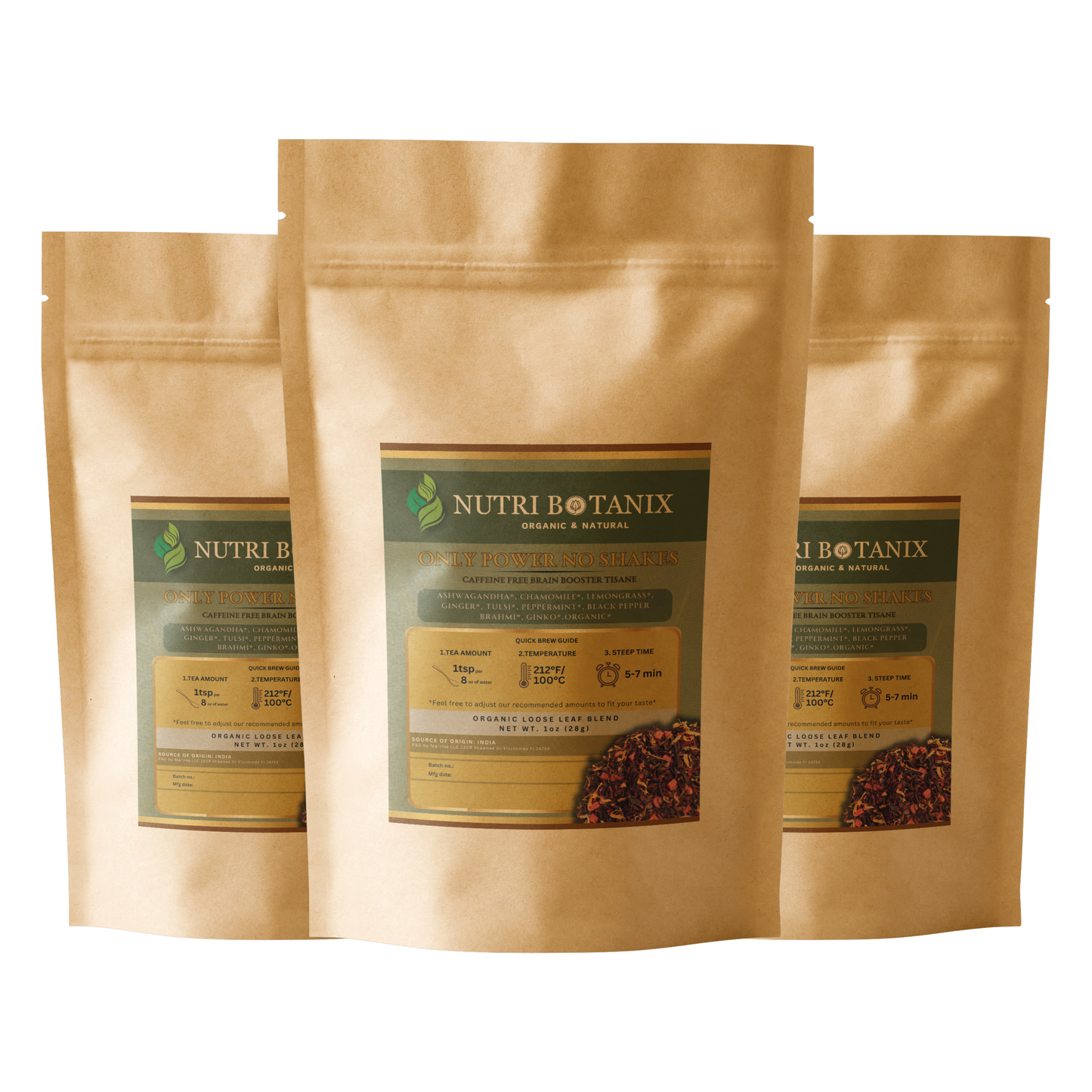
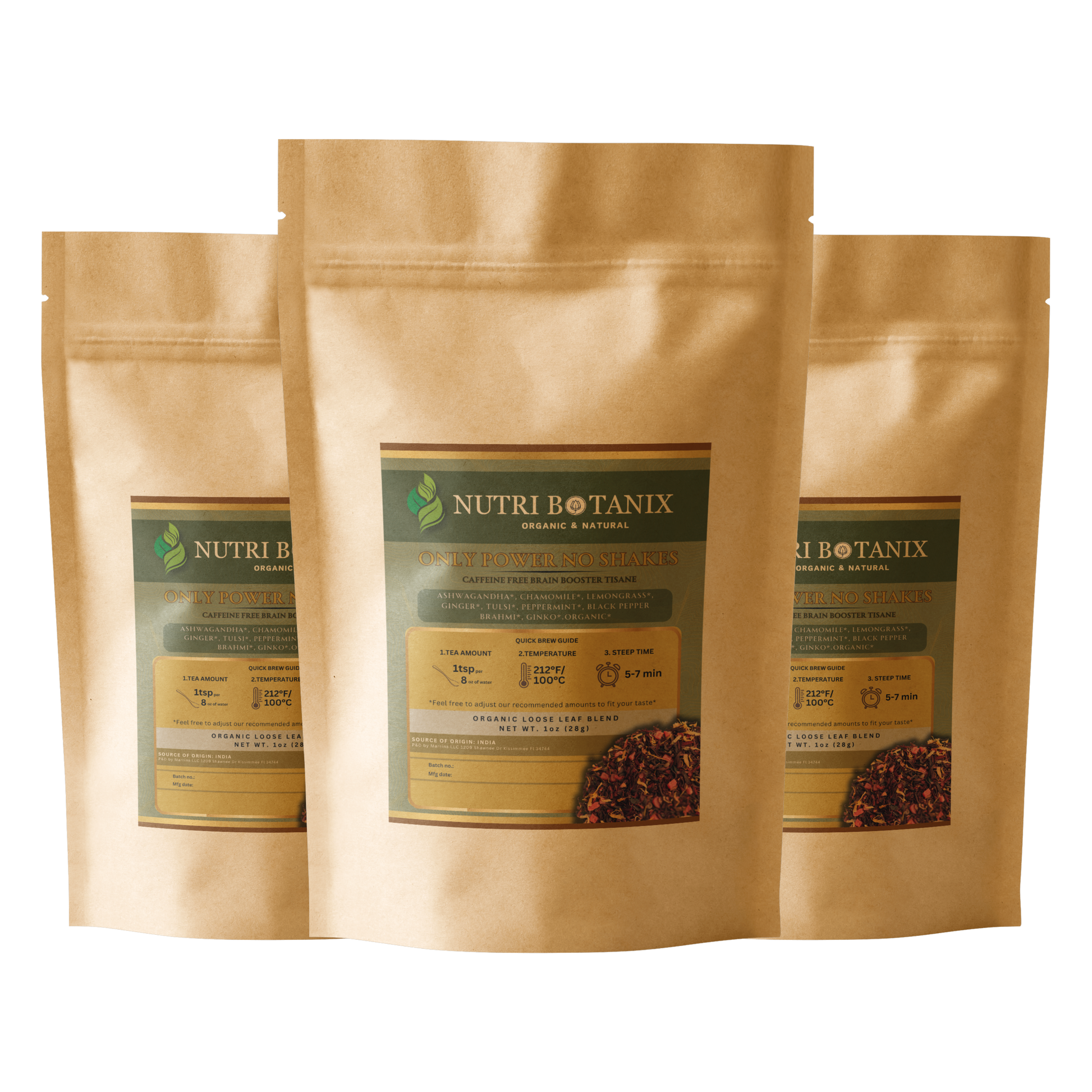
Only Power No Shakes Tea is a caffeine-free Ayurvedic herbal blend anchored by three classical adaptogenic botanicals — Ashwagandha, Brahmi, and Tulsi — and rounded out by aromatic culinary herbs from South Asian, Southeast Asian, Mediterranean, and East Asian botanical traditions. Chamomile, lemongrass, peppermint, ginger, black pepper, and Ginkgo bring flavor complexity and cultural depth to a formula built around the Ayurvedic Rasayana canon. There is no Camellia sinensis in this blend.
Contains no Camellia sinensis. This blend is caffeine-free by composition.
The Botanicals
Ashwagandha Root (Withania somnifera)
Ashwagandha — Sanskrit for “smell of the horse” — is one of the most foundational plants in Ayurvedic classical medicine, documented in the Charaka Samhita and Sushruta Samhita and holding a central place in the Rasayana tradition: a category of Ayurvedic practice concerned with nourishment, longevity, and the cultivation of vitality over time. A member of the nightshade family (Solanaceae), native to the drier regions of India, North Africa, and the Mediterranean, Ashwagandha qualifies as a true adaptogen — a botanical with deep, documented roots in classical Ayurvedic practice and centuries of traditional use. The root is earthy and slightly bitter, with a depth that anchors the base of this blend.
Brahmi (Bacopa monnieri)
Brahmi is a small creeping herb native to the wetlands of South Asia, found across India, Nepal, Sri Lanka, and parts of Southeast Asia. It takes its name from Brahma, the Hindu god of creation, and is associated with Saraswati, the goddess of knowledge and learning — a reflection of the high esteem in which this plant has been held in South Asian botanical and cultural history for centuries. Brahmi appears in the Charaka Samhita as a Rasayana botanical and qualifies as a true adaptogen with a long, documented tradition of use in Ayurvedic formulas. In this blend, Brahmi contributes a subtle, slightly bitter herbal note beneath the more aromatic botanicals.
Tulsi / Holy Basil (Ocimum tenuiflorum)
Tulsi — known as Holy Basil in English — holds one of the most significant places of any plant in South Asian cultural and botanical history. Cultivated in Hindu households, temples, and Ayurvedic gardens for millennia, it is classified in classical Ayurvedic literature as a Rasayana botanical and qualifies as a true adaptogen with centuries of traditional use across South Asia. Its flavor is complex: clove-like, slightly peppery, with a subtle sweetness. In this blend, Tulsi provides the aromatic bridge between the earthy Rasayana botanicals and the lighter culinary herbs.
Chamomile (Matricaria chamomilla)
Chamomile has one of the longest histories of any botanical in European and Mediterranean herbal tradition. Ancient Egyptians dedicated the plant to their gods and used it in medicinal preparations. Roman physicians documented its use extensively. Anglo-Saxon herbalists listed it among their nine sacred herbs. In medieval European physic gardens, chamomile was a foundational planting. Its use in botanical tea preparations stretches across cultures from Germany to Egypt to India. In this blend, dried chamomile flowers contribute their characteristic apple-like, lightly sweet floral character — the most immediately recognizable aroma in the cup.
Lemongrass (Cymbopogon citratus)
Lemongrass is a tall aromatic grass native to South and Southeast Asia, cultivated for centuries across Thai, Vietnamese, Indian, Sri Lankan, and West African culinary traditions. In Thai cooking it is foundational — appearing in tom yum, curries, and herbal preparations across the region. In India, lemongrass is used in Ayurvedic preparations and as a culinary herb across the subcontinent. Its bright, citrus-forward, slightly ginger-like aroma is one of the most distinctive in the herbal tea world. In this blend, lemongrass lifts the heavier Rasayana botanicals and gives the cup its bright aromatic opening.
Ginger (Zingiber officinale)
Ginger is one of the most globally distributed culinary botanicals in history — native to Southeast Asia and traded across ancient spice routes into South Asia, the Arab world, East Africa, and eventually Europe and the Americas. In South Asian and Ayurvedic tradition, dried ginger (Sunthi) appears across a vast range of classical compound formulas. In this blend, dried ginger provides warm, lightly spicy backbone that integrates the aromatic herbs with the earthy Rasayana base.
Peppermint (Mentha × piperita)
Peppermint is a hybrid mint — a natural cross between watermint and spearmint — with a botanical history stretching back to ancient Egypt, where dried peppermint leaves have been found in pharaonic tombs dated to 1000 BCE. Roman physicians wrote extensively about mint; medieval European monasteries cultivated it in their physic gardens. Peppermint’s distinctive bright, cooling character comes from menthol, its primary volatile compound. In this blend, peppermint provides the clean, bright top note that cuts through the earthy and spice botanicals and gives the cup its immediate aromatic freshness.
Black Pepper (Piper nigrum)
Black pepper is native to the Malabar Coast of Kerala, India, and has been one of the most significant commodities in the history of global trade — the spice that shaped the economics of the ancient spice trade and drove the European search for direct sea routes to India. In Ayurvedic tradition, black pepper is known as Maricha and appears in classical texts as one of the three components of Trikatu — a foundational Ayurvedic spice compound alongside ginger and long pepper. In this blend, black pepper contributes its characteristic sharp, warming pungency — a depth note that sharpens the aromatic profile of the cup.
Ginkgo Leaf (Ginkgo biloba)
Ginkgo biloba is one of the oldest living tree species on Earth, with a fossil record stretching back over 200 million years. Native to China, it has been continuously cultivated in Chinese and Japanese temple gardens for over a thousand years, sacred to Buddhist and Confucian traditions. Its leaves appear in Chinese herbal literature including the Ben Cao Gang Mu (Compendium of Materia Medica), compiled by Li Shizhen in the 16th century — one of the most comprehensive works in the history of East Asian botanical medicine. In this blend, ginkgo leaf contributes a subtle, slightly astringent, grassy character alongside its remarkable botanical history.
About This Blend
Only Power No Shakes Tea is built around three botanicals that each hold classical adaptogen standing in Ayurvedic tradition — Ashwagandha, Brahmi, and Tulsi — supported by six aromatic culinary herbs spanning from the wetlands of Southeast Asia to the apothecary gardens of medieval Europe to the spice markets of Kerala. The formula is caffeine-free by composition: every ingredient is an herbal botanical or culinary spice, with no Camellia sinensis. The flavor profile is layered — chamomile and lemongrass give the cup its aromatic, citrus-floral opening; peppermint provides a clean, cooling brightness; ginger and black pepper add warm spice depth; Ashwagandha and Brahmi anchor the base with earthy Rasayana character. It brews to a warm amber-gold with a complex, multi-layered aroma.
Brewing Instructions
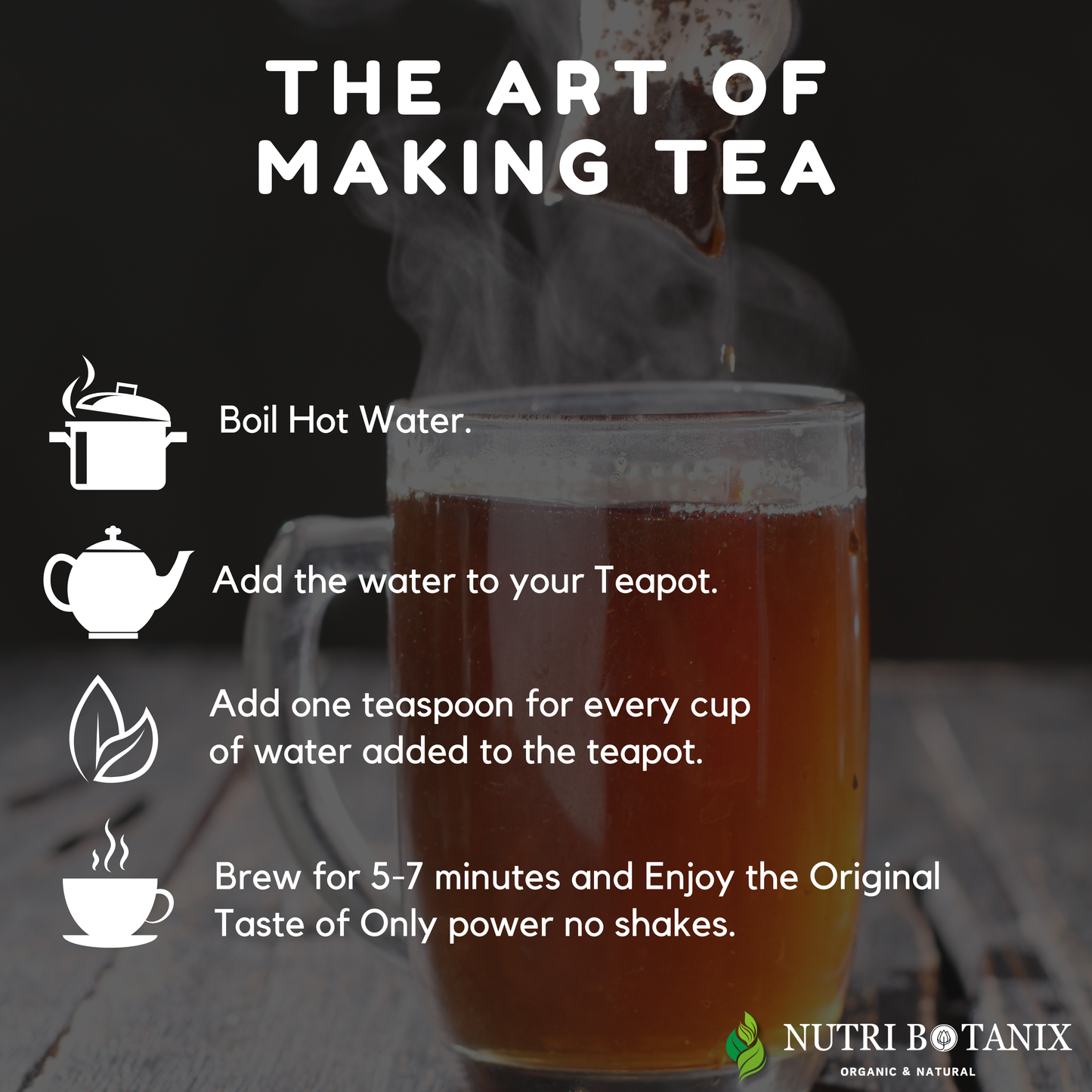
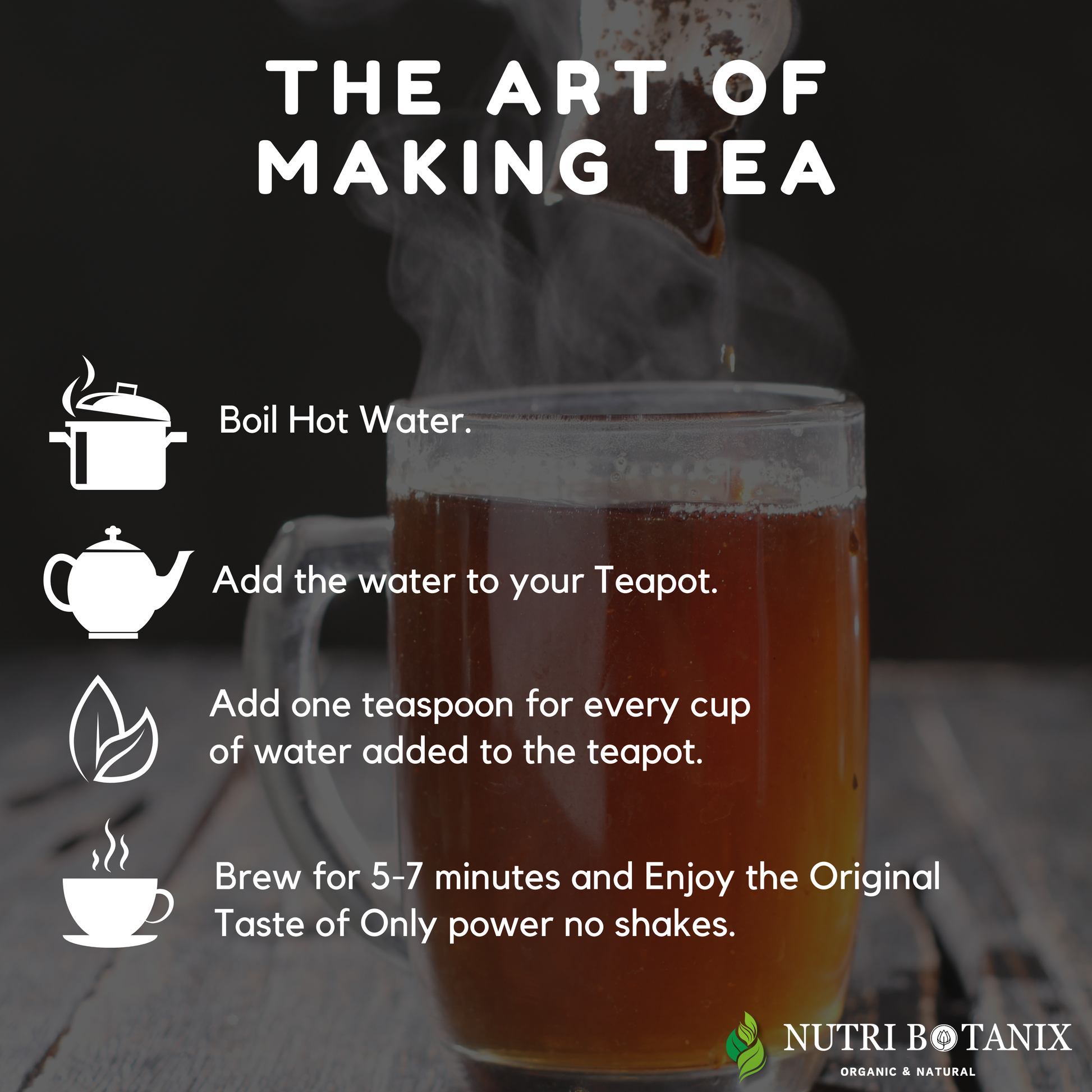
- Amount: 1–1.5 teaspoons per 8 oz of water
- Water temperature: 200–208°F (near boiling)
- Steep time: 5–7 minutes
- Vessel: Infuser basket, muslin bag, or French press
Herbal blends benefit from higher water temperatures and longer steep times than green or white teas. Chamomile and lemongrass are prominent at shorter steeps; Ashwagandha and Brahmi deepen with longer contact time. Peppermint can intensify significantly with extended steeping — start at 5 minutes and adjust to taste. Cold brew option: steep in room temperature water for 8–10 hours for a bright, aromatic iced herbal tea that foregrounds the lemongrass and peppermint character.
Honey Pairings
This blend pairs best with pure varietal honeys that complement its warm, complex spice-and-herb character.
Sourwood Honey — Sourwood is a light, delicate honey with a distinctive caramel-like sweetness and subtle anise finish, harvested from the blossoms of the sourwood tree (Oxydendrum arboreum) in the Appalachian highlands. Its clean sweetness integrates naturally with the peppermint and lemongrass brightness in this blend while adding a warmth that echoes the ginger and black pepper base. A pairing that rewards the blend’s complexity without overpowering it.
Wildflower Honey — Wildflower honey varies by region and season, reflecting the diversity of blossoms available to the bees at the time of harvest. Its fuller, more complex sweetness — floral, sometimes fruity, with depth that shifts batch to batch — pairs naturally with a multi-botanical formula as layered as this one. A good choice for those who prefer a more rounded, honeyed sweetness.
Related Products
- 5 O’Clock Fighter Tea — A botanical loose leaf blend featuring Ashwagandha, Brahmi, Tulsi, and Elderberry on a green tea base.
- Vitality Balance Tea — A caffeine-free Ayurvedic botanical blend featuring Tulsi, Gymnema, Pipli, and Rooibos.
- Mrs. T Tea — A caffeine-free Ayurvedic herbal blend featuring Shatavari, Tulsi, Fenugreek, and aromatic culinary herbs.
Frequently Asked Questions
What does “Only Power No Shakes” mean?
It’s a character name — direct, confident, and unapologetic. Like the T Series teas, it’s a personality, not a health claim. The name reflects the character of the blend: grounded Ayurvedic botanicals, aromatic culinary herbs, no caffeine.
Is this tea caffeine-free?
Yes. Only Power No Shakes Tea contains no Camellia sinensis — no green tea, black tea, white tea, or oolong. Every ingredient is an herbal botanical or culinary spice. This blend is caffeine-free by composition and can be enjoyed at any time of day.
What is an adaptogen, and which ingredients qualify?
Adaptogen is a botanical classification used to describe plants with a long, documented history of traditional use in practices such as Ayurveda and classical Chinese medicine. Plants in this category have long-documented roles in classical Ayurvedic and East Asian herbal traditions, incorporated into compound formulas for centuries. In this blend, Ashwagandha, Brahmi, and Tulsi each qualify as true adaptogens based on their documented standing in classical Ayurvedic literature. The term is used here in an educational and historical context.
What does this tea taste like?
The opening is bright and aromatic — chamomile’s apple-floral sweetness and lemongrass’s citrus lift are immediately present. Peppermint provides a clean, cooling top note. Through the middle, ginger and black pepper add warmth and spice depth. The earthy Ashwagandha and Brahmi are background notes that deepen with longer steeps. The overall character is complex, aromatic, and herbal — not sweet on its own, which makes Sourwood Honey a particularly effective pairing.
How much tea do I use per cup?
1 to 1.5 teaspoons per 8 oz of water, near boiling (200–208°F), for 5–7 minutes. Adjust to taste.
The botanical and cultural information provided on this page is for educational purposes only. For personalized guidance on any botanical ingredient, consult a qualified Ayurvedic practitioner or licensed healthcare provider.
These statements have not been evaluated by the Food and Drug Administration. This product is not intended to diagnose, treat, cure, or prevent any disease.
Share