

Traditional Use & Responsible Guidance
Traditional Use & Responsible Guidance
Product information is provided for educational and culinary purposes. Traditional use does not establish medical effectiveness. These products are not intended to diagnose, treat, cure, or prevent disease. Review ingredients and product-specific cautions; consult a qualified professional if pregnant, nursing, taking medication, managing a condition, or unsure whether a product is appropriate.
NutriBotanix
Don't sugar coat it tea
Don't sugar coat it tea
Couldn't load pickup availability
Caffeine-Free. This blend contains no Camellia sinensis (tea) and is naturally caffeine-free.
Don’t Sugar Coat It Tea
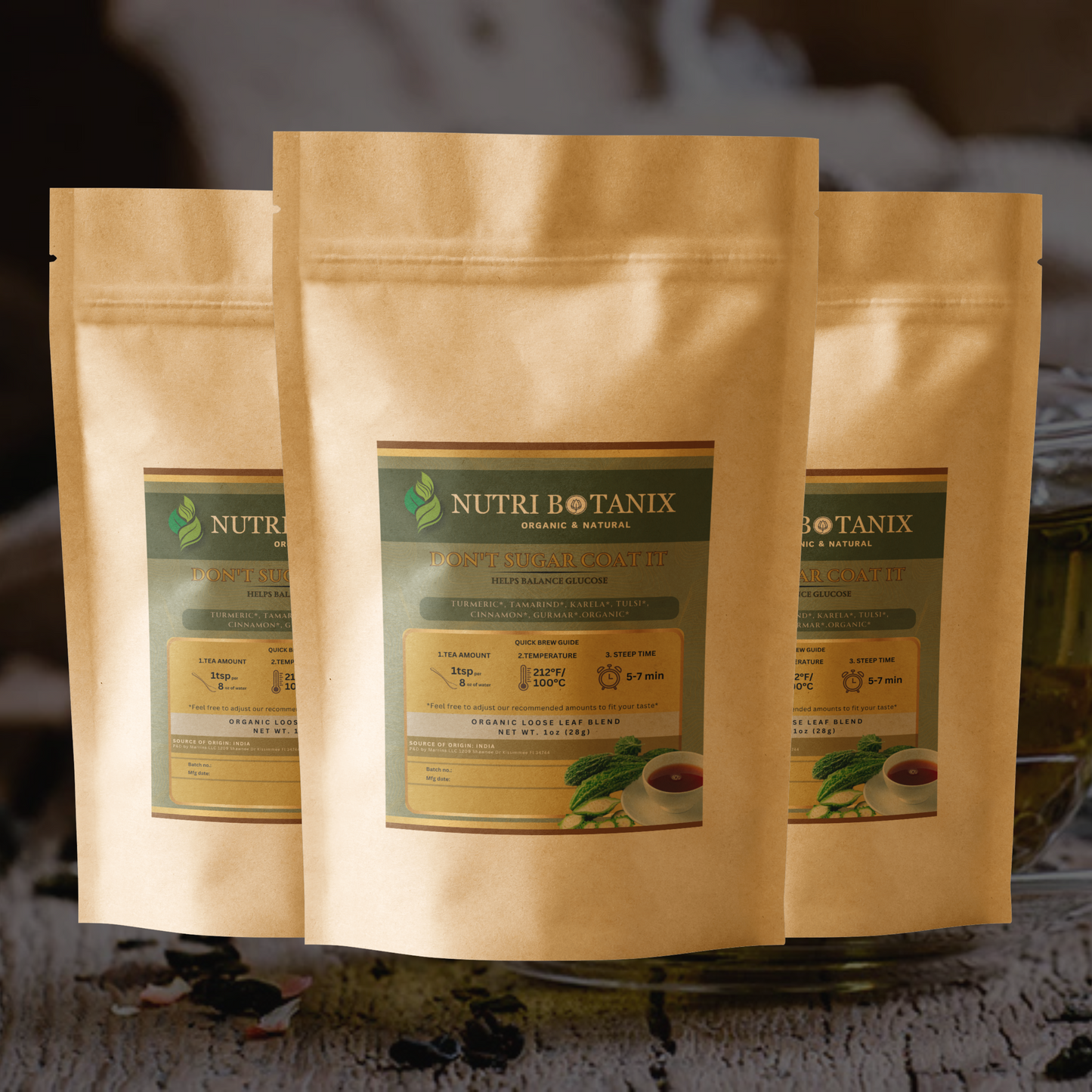
A bold, bitter, and deeply traditional Ayurvedic herbal blend. Six botanicals — karela from the markets of South Asia, gurmar from the Ayurvedic pharmacopoeia, turmeric from the kitchens of India, tamarind from cooking traditions across three continents, cinnamon from the spice routes of antiquity, and tulsi, the revered Rasayana herb of Hindu tradition. This is not a blend for those who prefer gentle cups. It is complex, assertive, and unapologetically herbal.
The Ingredients
Turmeric (Curcuma longa)
Turmeric is native to South Asia and has been a foundational spice in Indian, Sri Lankan, and Southeast Asian cooking for over 4,000 years. The Charaka Samhita and Sushruta Samhita both document turmeric extensively among Ayurvedic botanicals, and it appears in cooking traditions from Kerala curries to Malay rendang to Persian rice dishes. Its flavor is earthy, slightly bitter, and distinctly warm — the compound curcumin gives turmeric its characteristic deep golden color. In this blend, turmeric provides a grounding, earthy depth and contributes to the blend’s distinctive amber color when steeped.
Tamarind (Tamarindus indica)
Tamarind is native to tropical Africa and has been cultivated across South Asia, the Caribbean, and Latin America for centuries. In Indian cooking, tamarind pulp is one of the primary souring agents — it is the backbone of dishes from Tamil Nadu rasam to Mumbai chaat, and appears across the cuisines of Thailand, the Philippines, Jamaica, and Mexico. The Arabic name for it — tamar hindi, meaning “Indian date” — reflects how central the trade routes made it. Tamarind’s flavor is tart, fruity, and slightly sweet, with a distinctive complexity that no other souring agent quite replicates. In this blend, tamarind contributes its characteristic tartness and a fruity depth that rounds out the bitterness of the other botanicals.
Karela / Bitter Melon (Momordica charantia)
Karela — known in English as bitter melon or bitter gourd — is a widely cultivated vegetable across South Asia, Southeast Asia, East Africa, and the Caribbean. In Indian households, karela is a familiar kitchen staple: stuffed and pan-fried in Punjabi cooking, cooked with coconut in Kerala, stir-fried with egg in Chinese and Filipino cuisine, pickled in South Indian tradition. Its flavor is strikingly bitter — the most bitter of any commonly eaten vegetable — which is precisely why it has earned devoted fans across dozens of food cultures where bitterness is valued as a flavor in its own right. In Ayurvedic tradition, karela is documented as a Rasayana botanical and appears in classical texts including the Charaka Samhita. In this blend, karela is the defining flavor note — intensely bitter, deeply herbal, and immediately recognizable to anyone who grew up eating it.
Tulsi (Ocimum tenuiflorum)
Tulsi — known in English as Holy Basil — is among the most revered plants in Indian botanical and cultural tradition, with documented use in Ayurvedic texts for over 3,000 years. The Charaka Samhita classifies tulsi among the Rasayana botanicals — plants used in traditional wellness systems to support balance and resilience over time. Tulsi is recognized as an adaptogen within the Ayurvedic framework, reflecting its traditional role as a plant used to help the body adapt to changing conditions. Its flavor is complex — peppery, slightly clove-like, herbal, and aromatic. It has deep spiritual significance in Hindu tradition, where it is often grown and tended in the home as a sacred plant. Adaptogen terminology is used here in its traditional Ayurvedic context, not as a health claim.
Cinnamon (Cinnamomum spp.)
Cinnamon has one of the most ancient spice histories in the world — it was traded along the spice routes of the ancient Mediterranean, referenced in Egyptian, Hebrew, and Sanskrit texts, and was among the most prized commodities in the Silk Road trade. Ceylon cinnamon, native to Sri Lanka, and cassia cinnamon from South China are the two primary commercial varieties, each with a distinct flavor profile: Ceylon is softer and more delicate; cassia is bolder and more pungent. In South Asian cooking, cinnamon appears in everything from biryani and chai to Ayurvedic preparations. In this blend, cinnamon contributes a warm, familiar sweetness that softens the assertive bitterness of the karela and gurmar.
Gurmar (Gymnema sylvestre)
Gurmar is a woody climbing plant native to the tropical forests of India and Africa, where it grows in the humid hill forests of the Western Ghats, Maharashtra, and Tamil Nadu. It has been documented in Ayurvedic texts for over 2,000 years, classified among the Rasayana botanicals in classical texts including the Charaka Samhita. Gurmar has been part of traditional herbal practice in Indian folk medicine and Ayurvedic formulations for generations, valued within that tradition as a long-term botanical. Its flavor is intensely bitter, somewhat woody, and highly distinctive — it is one of the more potent-tasting botanicals in this blend. See the Botanical Consultation Note below regarding gurmar consumption guidance.
About the Blend
Don’t Sugar Coat It Tea is named for what it is — a blend that makes no concessions to easy palatability. Karela is the most bitter common vegetable in the world. Gurmar is among the most bitter botanicals in the Ayurvedic pharmacopoeia. Tamarind brings tartness. Turmeric brings earthiness. Cinnamon and tulsi provide the only sweetness and warmth in the cup. The result is a herbal blend that is complex, assertive, and rooted in centuries of Ayurvedic and culinary tradition across South Asia. It is not for everyone. For those who know these flavors from their kitchens and their family’s remedies, it will taste like home.
Brewing Guide
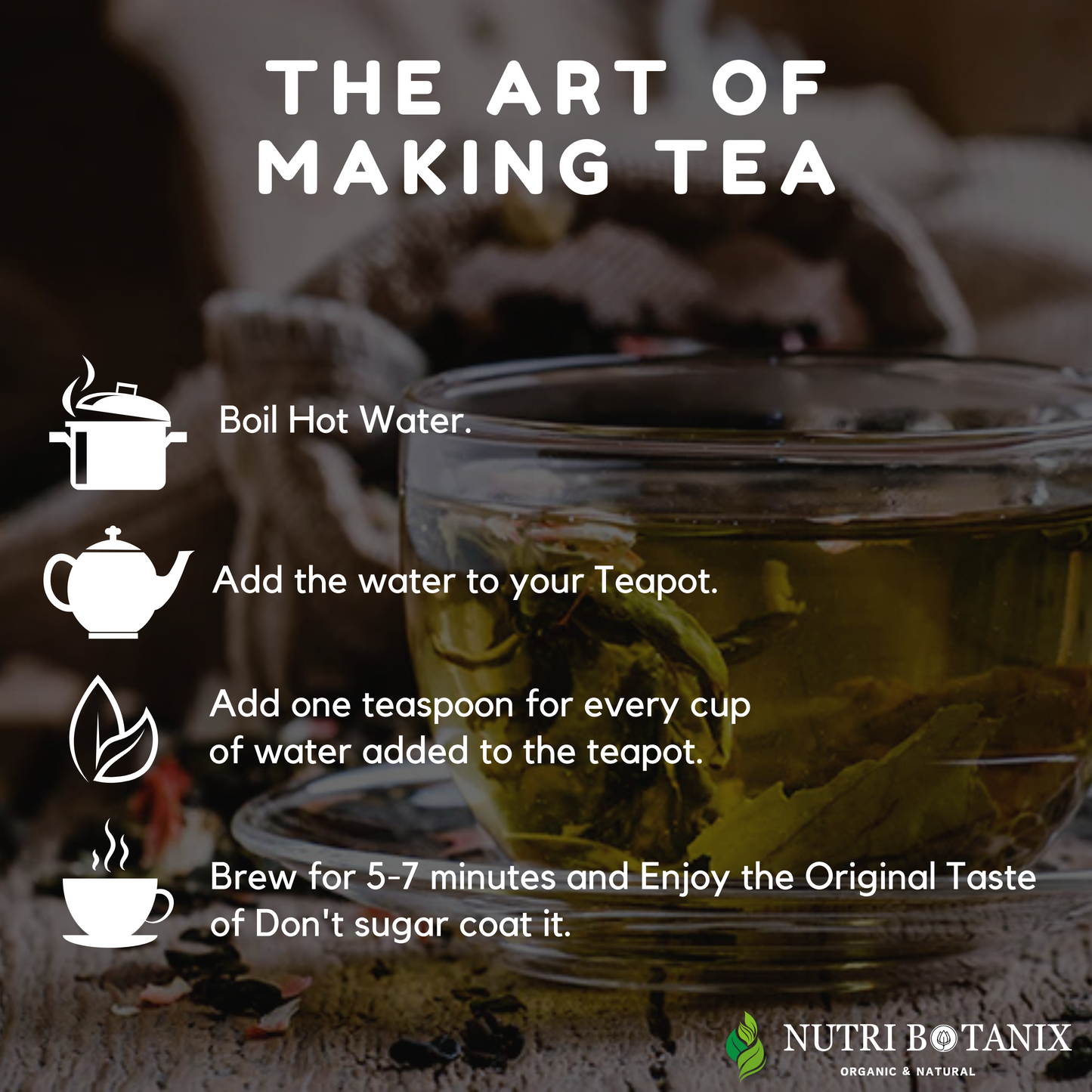
Use 1 teaspoon per 8 oz of water. Heat water to 200–212°F (93–100°C) — a full or near-full boil is appropriate for this robust herbal blend. Steep for 5–7 minutes. The bitterness intensifies with longer steeping; start at 5 minutes and adjust to taste. A small amount of honey can soften the bitter edge without masking the blend’s character. This blend does not respond well to cold brewing — the bitterness compounds at lower temperatures without the warmth that integrates the flavors.
Honey Pairings
This is a deeply bitter herbal blend. Honey pairings should be bold enough to hold their own against the karela and gurmar without creating an overly sweet result.
- Wildflower Honey — Our primary pairing. Wildflower honey has a rounded, complex sweetness with earthy undertones that complement rather than fight the herbal intensity of this blend. Use sparingly — the goal is balance, not sweetness.
- Tupelo-Blackberry Honey — A secondary option. Its smooth, buttery Tupelo base and light blackberry-blossom floral note soften the bitter edge of karela and gurmar, and the tamarind's tartness gives that floral note something to play against.
Brewing Tools
The right tools make loose leaf tea simple.
- Unbleached Disposable Tea Bags — Single-use, unbleached, chlorine-free. Fill, steep, discard. No strainer required.
- Heart-Shaped Tea Infuser — Reusable stainless-steel infuser for everyday loose-leaf brewing. Fits standard mugs and teacups.
Related Products
- Wildflower Honey
- Tupelo-Blackberry Honey
- After We Feast Tea
- Stay Fit Tea
Frequently Asked Questions
Is this tea caffeine-free?
Yes — this blend contains no Camellia sinensis (tea leaf) and is naturally caffeine-free. All six ingredients are herbs, spices, or vegetables.
Why is this blend so bitter?
Karela (bitter melon) and gurmar (Gymnema sylvestre) are both intensely bitter botanicals that are prized in South Asian culinary and Ayurvedic traditions precisely for their distinctive flavor. The bitterness is intentional and is part of the blend’s character.
Can I add honey?
Yes — a small amount of honey softens the bitter edge while still allowing the herbal complexity to come through. Start with a small amount and adjust. We recommend Wildflower or Tupelo-Blackberry honey.
Is this blend related to blood sugar or diabetes?
No — this is a traditional herbal blend rooted in Ayurvedic botanical tradition. We make no claims about blood sugar, glucose, or any health condition. If you have a medical condition or take medications, consult your healthcare provider before adding any botanical blend to your routine.
How much should I use?
Start with 1 teaspoon per 8 oz. This is a potent herbal blend — more tea leaf does not mean a better cup here. Many customers find 1 teaspoon is plenty.
Botanical Consultation Note
This blend contains gurmar (Gymnema sylvestre), a potent Ayurvedic botanical with a long history of traditional use. If you are pregnant, nursing, taking any prescription medications, or managing a health condition, consult a qualified healthcare provider or Ayurvedic practitioner before regular consumption of this blend.
Continue learning
Learn more about gurmar, turmeric, and the other botanicals in this blend in our Botanical Ingredient Library.
These statements have not been evaluated by the Food and Drug Administration. This product is not intended to diagnose, treat, cure, or prevent any disease.
Share